









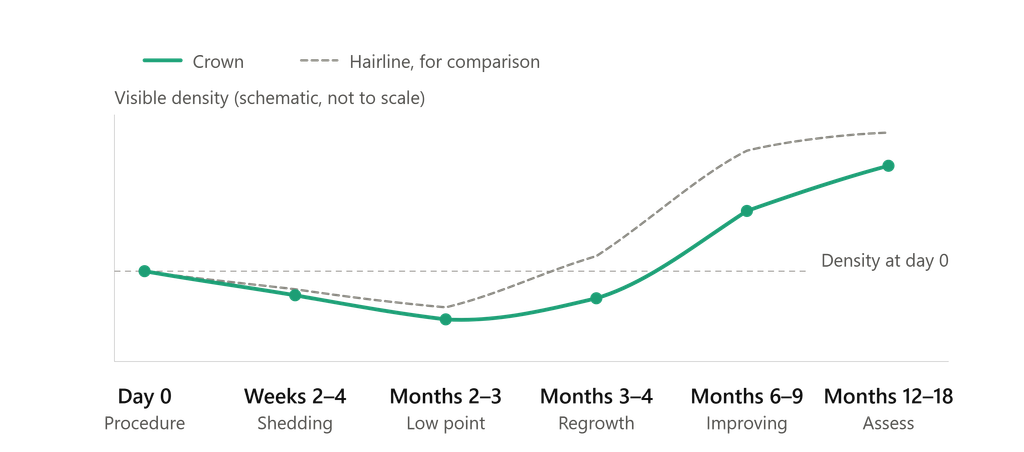
It is the sequence the hair cycle imposes on every transplant, and at the vertex it plays out on a longer clock.
At Ideal of MeD, crown work is planned as part of the whole scalp rather than as a patch. Depending on the case, the plan may use Ideal ICE FUE Sapphire for broad coverage, Ideal ICE DHI for angle control, or Ideal Combination Surgery to do both in one session. Recovery is tracked through the Hair Back App, which matters more at the crown than anywhere else, because this is the zone where patients most often conclude too early that something went wrong.
Key points
- Transplanted hairs shed 2 to 4 weeks after surgery. The follicle stays in the scalp.
- Regrowth typically starts at 3 to 4 months, and new hairs usually appear within 3 to 6 months of shedding.
- The crown commonly matures 4 to 6 months later than the frontal hairline.
- Judge a crown result at 12 to 18 months, not at 12.
- Thin at month 6 is expected. Zero growth across a large area at month 12 is not.
Why the crown runs behind the hairline
Two things are going on here, and they are not equally well established.
The observable part is not in dispute. Frontal and mid-scalp grafts commonly look close to final at 9 to 12 months, while the vertex keeps changing for several months after that. Hair caliber continues to increase after new hairs have already emerged, so the crown can keep looking fuller without a single new hair appearing.
The usual explanation is vascular. The vertex sits furthest from the occipital and superficial temporal arteries, so blood supply there is described as less robust, which would slow the growth cycle from restarting. This explanation is repeated almost universally in clinic literature, but the direct evidence linking vertex perfusion to a measurably slower regrowth rate is thinner than the confidence with which it is stated. Treat it as the leading explanation rather than a settled finding.
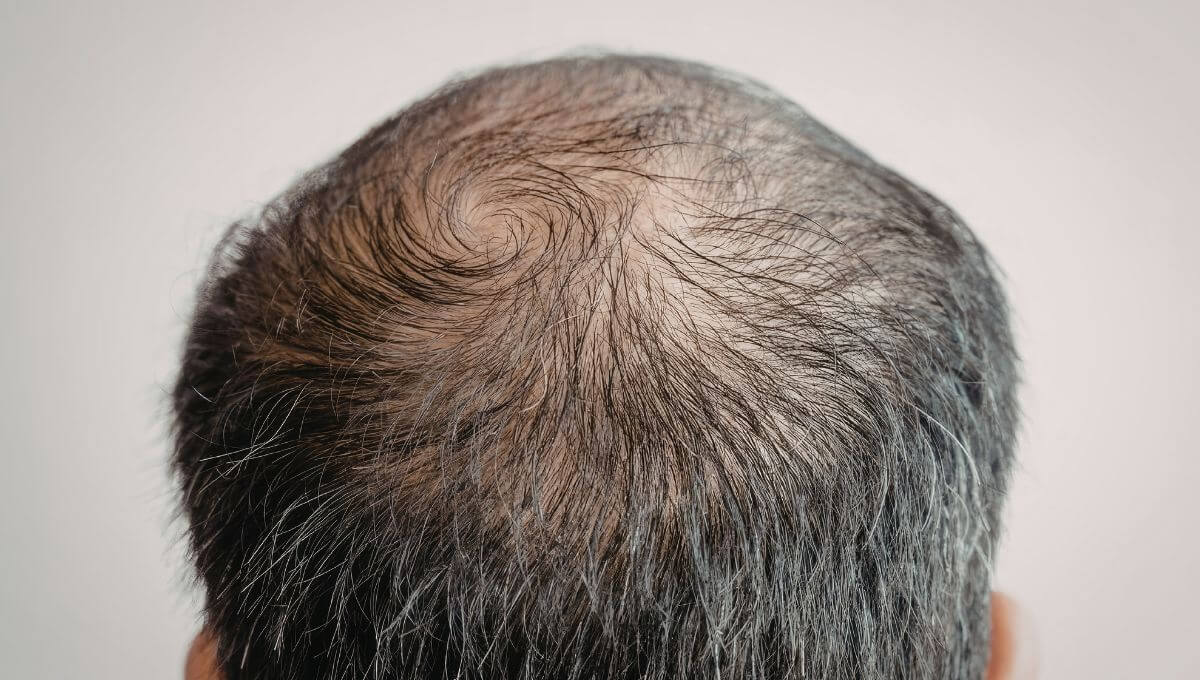
There is also a simpler geometric reason that gets less attention and probably deserves more. The crown is convex, it is normally viewed from above or behind, and the hair grows outward from a whorl in a radial pattern. At the hairline, even modest early growth reads as a visible frame. At the crown, partial growth still shows scalp between hairs from the one angle everybody looks at it from. The same amount of regrowth simply looks like less.
Stage by stage
Day 0 to day 14: healing, not growing
Crusting forms around each graft and clears over roughly the first one to two weeks. Redness in the recipient area is normal and fades gradually. Nothing about density can be judged in this window.
The crown has a practical problem the hairline does not: it is the part of the head that rests on a pillow. Sleeping elevated and using a travel pillow to keep the vertex off the surface is standard advice in the early nights. Patients treated with us get their pre-op kit within a week of booking, and the aftercare app walks through the sleeping position for the first phase.
Weeks 2 to 8: shedding, and the point where people start worrying
Transplanted hair shafts fall out. This is expected. The follicle bulb remains under the scalp, and the hair that comes out is the shaft, not the follicle.
There are two separate processes behind it. The transplanted grafts shed early, driven by the temporary interruption of their blood supply during extraction and placement. Separately, native hairs in and around the treated area can be pushed prematurely into the resting phase by the stress of surgery, and that shedding shows up later, typically around two to three months after the trigger. That second mechanism is why some patients see thinning in areas that looked fine before the operation, and why the crown can briefly appear worse than the pre-op photos.
Both are transient. Shock loss is temporary, and new hairs typically appear after three to six months, according to the hair transplantation chapter in StatPearls.
Months 2 to 3: the low point
This is the bottom of the curve. Shedding has finished or is finishing, the follicles are in their resting phase, and the crown looks emptier than it did the week before surgery. Nothing is visibly happening because nothing visible is meant to be happening yet. The resting phase of the hair cycle lasts around two to three months on its own.
If you are going to lose confidence in the procedure, this is when it happens. It is also when the least information is available.
Months 3 to 4: regrowth begins
Fine, pale hairs start to emerge. They are thin, sometimes almost colorless, and easy to miss under bathroom lighting. Over the following weeks they thicken and darken. Some patients report a tingling or prickling sensation in the treated area during this phase.
Density at this stage is still low, and at the crown it is lower than at the hairline for the geometric reasons above. Our search data shows a steady stream of people looking for crown photos at exactly the four-month mark, which tells you how normal this uncertainty is.
Months 6 to 9: visible improvement
This is where the result becomes something you notice in the mirror rather than something you look for. Hairs are terminal rather than fine, and coverage starts to read as coverage. A hairline treated in the same session will be clearly ahead of the crown here, and combined procedures produce a genuinely lopsided six-month photo. That asymmetry is normal and resolves.
Months 12 to 18: the actual assessment point
For the hairline, twelve months is a fair verdict. For the crown it is not. The vertex commonly needs 12 to 18 months to mature, and in some cases longer. During that window hair caliber continues to increase, which adds visual volume without adding hairs.
Regular follow-up over the 6 to 12 months after surgery, until the grafts have fully matured, is the standard clinical expectation. Twelve months is also the earliest sensible point to discuss whether a second session would add anything.
“No density at 6 months” is one of the most searched phrases in hair restoration
It gets searched at five months, six, seven and nine, which tells you these are people checking whether their specific month is the month it should have worked by. For the crown, month six is early and month nine is still inside the normal window.
What separates incomplete maturation from a real problem is what you can see, not the date:
| Normal at this stage | Worth contacting your clinic |
| Hairs present but fine and thin | No growth at all across a large area at 12 months |
| Crown clearly behind the hairline | Signs of infection, spreading redness, discharge |
| Density improving but not yet level | Severe or escalating pain |
| Temporary thinning of native hair nearby | Visible scarring or ridging in the recipient zone |
| Patchy coverage that is filling unevenly | A result that looks worse than the pre-op baseline at 12 months |
Not all post-transplant shedding is shock loss. It can occasionally reflect infection, inflammation or scalp disease, so symptoms beyond thinning are worth reporting rather than waiting out. Patients treated with us have 24 hour support and ongoing check-ins through the aftercare app, which exists partly so this judgment does not have to be made alone at month six.
Why crown density is lower than the hairline with the same graft count
The crown is a broad, two-dimensional area with hair radiating outward from a whorl. Covering it convincingly takes more grafts than a comparable frontal zone, and the achievable density is typically lower even when graft numbers are matched, because the coverage has to be spread across a wider surface viewed from an unforgiving angle.
This is also why crown planning has to account for what happens next. The vertex is highly susceptible to continuing DHT-driven loss, so transplanted hairs can end up surrounded by native hair that keeps thinning. Surgeons commonly recommend medical therapy alongside crown work for that reason. Which drug, dose and duration are clinical decisions rather than article content, and they belong in a consultation. Our surgical team is led by Dr. Devrim Demirel, an ISHRS member who has performed over 8,000 procedures, and crown planning is part of the initial assessment rather than an afterthought.
Frequently asked questions
How long does a crown hair transplant take to grow?
Regrowth generally starts at three to four months, becomes visibly convincing between six and nine months, and reaches its final form between twelve and eighteen months. That is roughly four to six months behind a frontal hairline treated in the same session. If you are at month six and disappointed, you are not close to the end of the process yet.
Is it normal to have no density in the crown at 6 months?
Yes, for the crown specifically. At six months many patients have hairs that are present but still fine, and the crown is normally the last zone to look full. Low density at six months is not predictive of the final result. Complete absence of growth across a large area at twelve months is a different situation and warrants review.
Does the crown shed more than the hairline?
Shedding of transplanted hair happens across the whole recipient area. Shock loss affecting surrounding native hair can be more noticeable at the vertex, partly because there is often more thinning native hair there to begin with. Both types of shedding are temporary, and the follicles remain in place beneath the scalp.
Can I judge my crown result at 12 months?
For the hairline, twelve months is a reasonable verdict. For the crown it is premature. Hair caliber keeps increasing past the twelve-month mark, so the crown can continue to look fuller without new hairs appearing. Twelve months is the right time to review progress with your surgeon, and eighteen months is the fairer point for a final judgment.
How many grafts does the crown need?
There is no single number, because it depends on the size of the thinning area, your donor reserve and the density you are aiming for. The crown generally needs more grafts than an equivalent frontal area to look equally full, since coverage is spread across a wider, convex surface. A photo assessment is the only way to get a figure that means anything.