









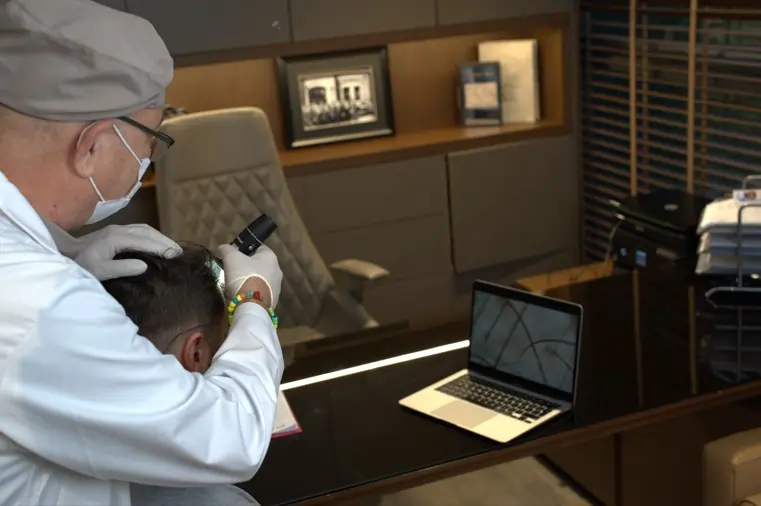
Most questions have reassuring answers. A few do not, and we would rather you heard those from us than found them out later.
Our surgical team is led by Dr. Devrim Demirel, a member of the International Society of Hair Restoration Surgery who has performed over 8,000 procedures, working alongside Dr. Muzaffer Akkaya, also an ISHRS member, with more than 20 years in the field.
1. What actually happens during a hair transplant?
Individual follicles are taken from the back and sides of your head, where hair is genetically resistant to the hormone that causes pattern baldness, and placed into the thinning area at the front or top.
That is the whole idea. It is your own hair, moved. Nothing is added and nothing is manufactured.
Two consequences follow from that, and they matter more than any technique detail. First, the supply is finite. You have a fixed number of follicles in the donor area and every procedure spends some of them permanently. Second, moving hair does not stop hair loss. The follicles that were already thinning around the transplanted ones carry on thinning.
Most clinic pages answer this question with a comparison of techniques. We use Ideal ICE FUE Sapphire, Ideal ICE DHI and a combination of both depending on the case, and the differences between them are real. Which one suits you is a decision we make together once we have seen your hair loss and donor area, not something you need to have researched before you get in touch.
2. Will it look natural?
This is the question underneath most of the others, and it is the one we design around first.
A natural hairline is not a straight line. It is irregular, it has a soft transition zone rather than a hard edge, and the leading edge is built from single-hair grafts so that nothing looks planted. It also sits higher than most people in their twenties would like, because a hairline has to look right at 50 as well as at 25.
The most common reason a transplant looks obvious is that this was ignored: a hairline drawn too low and too straight looks dense in the first year and wrong for decades afterwards. The ISHRS lists exactly this among the most common reasons patients come back for corrective work, and adds a detail worth knowing, younger patients often push the surgeon toward that aggressive low hairline themselves.
Part of our job in a consultation is to design something you will still be happy with in twenty years, and occasionally to talk you out of something you want today. Angle and direction matter just as much: hair leaves the scalp at an angle that changes across the head, and getting that right is what makes a result invisible.
3. How many grafts do I need?
Nobody can answer this reliably before assessing the donor area. What the number actually depends on: the size of the area you want covered, the density already there, the density you are aiming for, and above all how much donor hair you have available to spend. A larger graft count is not automatically better. Grafts taken beyond what the donor area can safely give produce visible thinning at the back, which is permanent and difficult to correct.
A higher number is easy to sell and hard to undo. Treat it as a constraint being described to you, not a product being upgraded.
4. Is my donor area big enough?
For most patients, yes, and this is usually the reassuring part of a consultation. It is also the question that determines the answer to every other one, and the one patients ask least.
The donor area is your entire budget, for this procedure and for every procedure you might want later. We assess it on density, hair calibre, scalp laxity and the size of the safe zone, and it sets the ceiling on what is achievable.
Occasionally it is not enough for what someone has in mind. The ISHRS is direct about this: where donor supply is insufficient, correction may be challenging or impossible, and there are cases in which no surgery should be performed at all. Goals that are too ambitious for the donor available and the severity of the loss are another reason they list.
We follow that guidance. It means we would rather have an honest conversation before a deposit than deliver a result you are disappointed by, and it is the same standard that protects the patients we do operate on.
5. Am I too young for a hair transplant?
Possibly, and this is the question where patient and surgeon disagree most often.
The reason is timing. Pattern hair loss is progressive, so a 22-year-old does not yet know where their loss will stop. Operating early means spending donor follicles on a pattern that will keep changing, and it means the result may need defending with further surgery at 30 and again at 40, from a donor area that is smaller each time.
This is not a fringe concern. The ISHRS 2025 Practice Census found that 95% of first-time hair restoration patients began treatment between the ages of 20 and 35. The field is operating on young men in large numbers.
Being young does not rule you out. It changes the plan, usually toward a more conservative hairline and a strategy that leaves donor hair in reserve for later. That is a better outcome than an aggressive result at 24 with nothing left to defend it with.
6. Why is the crown so much slower than the hairline?
Because the timelines are genuinely different, and a combined procedure produces a lopsided six-month photograph as a result. This is one of the most common reasons patients contact us worried, and almost always nothing is wrong.
Transplanted hairs shed two to four weeks after surgery while the follicle stays in place, and new hairs typically appear three to six months after that shedding, with follow-up continuing for six to twelve months until the grafts have fully matured. A frontal hairline commonly looks close to final somewhere between nine and twelve months. The crown often keeps changing for six months beyond that.
The usual explanation is vascular: the vertex sits furthest from the main arteries supplying the scalp, so blood supply there is described as less robust. We would flag that this is the leading explanation rather than a settled finding. The anatomy is not in dispute, but the direct evidence tying vertex perfusion to a measurably slower growth rate is thinner than the confidence with which the industry states it.
There is also a simpler reason that gets less attention. The crown is convex, it is viewed from above, and hair radiates outward from a whorl. Partial regrowth at the hairline reads as a visible frame. The same amount of regrowth at the crown still shows scalp between hairs from the one angle everybody looks at it from.
7. When should I start worrying that my hair transplant has not worked?
Not at month three, which is when most people do.
Months two to three are the low point by design. The transplanted hairs have shed, the follicles are in their resting phase, which lasts roughly two to three months on its own, and the area can look emptier than it did the week before surgery. Some native hair nearby may also shed temporarily from the stress of the procedure, which shows up around the same time. Both are transient, and both are expected.
What separates incomplete maturation from a real problem is what you can see, not the date on the calendar. Fine, thin hairs at month six are normal. The crown lagging behind the hairline is normal. No growth at all across a large area at twelve months is not, and neither are signs of infection, spreading redness, discharge, severe or escalating pain, or visible scarring in the treated area.
Not all shedding after a transplant is the expected kind. It can occasionally reflect infection, inflammation or scalp disease, which is why symptoms beyond thinning are worth reporting rather than waiting out. You will not be working this out alone: our patients have ongoing check-ins and 24 hour support through the Hair Back App, precisely so there is someone to ask at month six.
8. Is it permanent?
The transplanted hair, generally yes. The result lasts when it is planned for the long term, which is what a good consultation is actually for.
Follicles taken from the resistant donor zone keep that resistance when they are moved, so the grafts themselves persist. What they do not do is protect the native hair around them, and that hair can continue to thin. The ISHRS treats this as a distinct reason patients return years later: a good result at 30 can look unnatural at 40 purely because the surrounding hair kept receding.
The reassuring part is the same source’s other finding. Where a proper long-term plan was established before the first surgery, subsequent procedures should improve the situation considerably. Planning for where your loss is heading, rather than only for how it looks now, is the difference between a result that ages well and one that does not. It is the least glamorous part of a consultation and the part that determines whether you are happy in 2040.
9. Does a hair transplantation hurt?
Local anaesthetic is used, and the anaesthetic injections are the part patients most often describe as uncomfortable. The procedure itself is generally not painful, but it is long, and sitting still for hours is its own kind of difficult.
We are deliberately not claiming it is painless. Clinics that do are describing marketing copy rather than a surgical day, and patients who arrive expecting nothing tend to be the ones who report the worst experience. Knowing what the day involves is the thing that makes it easy.
If you want an assessment of your own case, contact us. Our team will tell you what they think is achievable, and consultation is free. Most of the time that conversation is straightforward and the answer is yes. When it is not, you will hear that too.