





Written by the Ideal of MeD team · Expert commentary by Dr Devrim Demirel, Head of Surgery
To work out the best time to get a hair transplant for you, here’s what each season means for your recovery, how to time your procedure around the results you want, and when it makes most sense to come to Istanbul.
Winter: the easiest season for recovery
The season doesn’t change how grafts are extracted or implanted. It changes how easy the first few weeks are, and that’s where winter quietly wins.
Hats are normal. Once your surgeon says it’s safe to wear one, usually a loose-fitting style, a hat in December draws no attention at all. In July it’s harder to explain.
Less sun on a healing scalp. Your newly treated scalp needs protecting from direct sun for several weeks. Short, grey days make that easy instead of a daily effort.
Less sweating. Heavy sweating is best avoided while the grafts settle. Cooler weather means fewer sweaty commutes, and less temptation to hit the beach or the pool, which are usually off-limits for a while after surgery.
A quieter calendar. Many people can take a few days off around the holidays, recover at home, and return in January with little to explain.
Spring: mild weather, longer days
Spring is a comfortable middle ground. The weather is mild, and a hat still looks natural on cooler days. The sun gets stronger toward late spring, so protecting your scalp matters more the later in the season you go. A spring procedure typically means visible change by autumn.
Summer: a good choice, with more discipline
Plenty of patients have their procedure in summer and get excellent results. Grafts don’t grow better or worse depending on the month.
What summer asks for is more discipline: covering up in the sun, avoiding heavy sweating and skipping swimming for as long as your surgeon advises. In return, summer is often the easiest time to take a break from work, and visible change tends to arrive around midwinter, in time for the new year.
Autumn: a popular all-rounder
Autumn combines mild weather with a natural run into hat season. Many patients like having the first weeks of recovery behind them before the winter holidays, with visible change typically showing by spring.
How to time your hair transplant around your results
Whatever the season, the most useful way to pick a date is to work backwards from when you want to see a difference.
After a hair transplant, most transplanted hairs shed within the first few weeks. That’s normal: the follicles stay in place and rest before regrowing. New growth typically starts around three to four months, noticeable change often shows around six months, and the full result usually takes 12 to 18 months.
As a rule of thumb, visible change tends to show about six months after your procedure:
| Procedure in | Visible change often by |
|---|---|
| Winter (Dec to Feb) | Summer (Jun to Aug) |
| Spring (Mar to May) | Autumn (Sep to Nov) |
| Summer (Jun to Aug) | Winter (Dec to Feb) |
| Autumn (Sep to Nov) | Spring (Mar to May) |
The full result usually takes 12 to 18 months, whichever season you start in. Here’s how that looks for a winter procedure, one of the most popular choices:
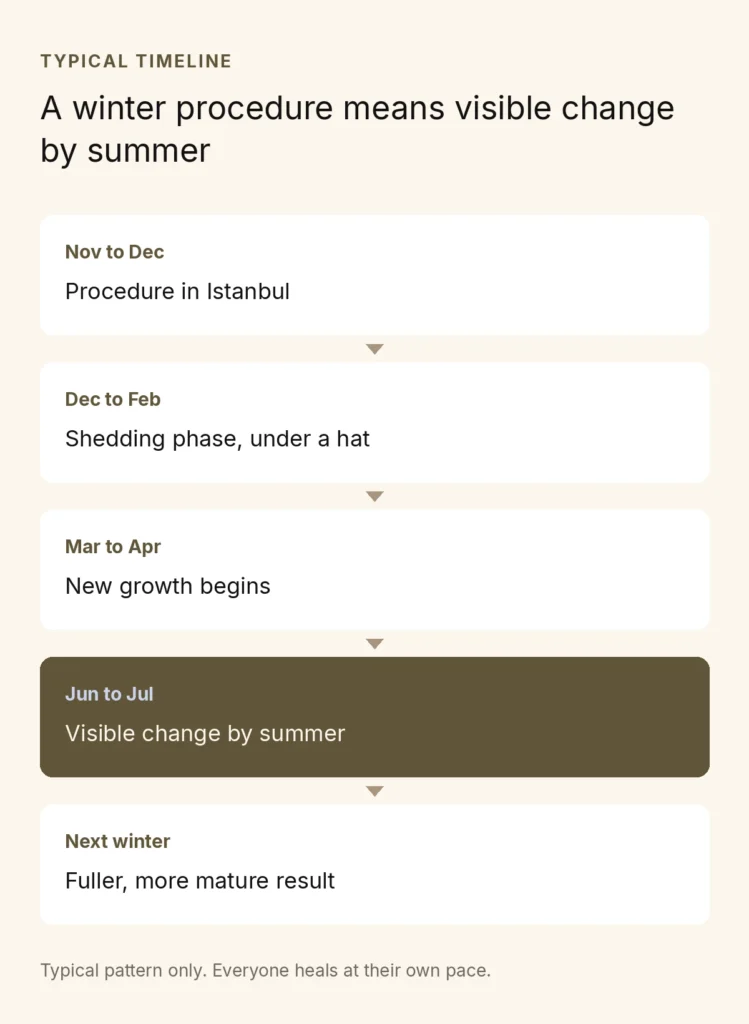
With a winter date, the least flattering months happen when you’re wearing a hat anyway, and you go into summer with growth already underway. Everyone heals at their own pace, so treat these months as a typical pattern, not a promise.
When is the best time to go to Turkey for a hair transplant?
If you’re travelling to Istanbul, the season shapes your trip as much as your recovery. Here’s how the year looks from our side of the flight:
| Season | Istanbul weather | What it means for your trip |
|---|---|---|
| Winter (Dec to Feb) | Cool and often rainy | Off-peak travel, quieter city, easy to stay covered and indoors while you rest |
| Spring (Mar to May) | Mild, warming up | Comfortable for getting around; sun gets stronger toward May |
| Summer (Jun to Aug) | Hot and humid | Peak tourist season; sun and sweat need careful managing |
| Autumn (Sep to Nov) | Mild, cooling down | Pleasant weather, and recovery runs straight into winter at home |
For many international patients, late autumn and winter hit the sweet spot. The weather in Istanbul helps rather than hinders those first days, and off-peak flights and hotels are often easier to book.
One thing to plan around in summer: Istanbul is a tempting city to explore, but long days of sightseeing in the heat aren’t ideal straight after surgery. If you want a holiday too, consider doing the sightseeing before your procedure rather than after.
Whatever the season, ask us how long to plan your stay for. It depends on your treatment plan and your first check-up and wash.
Winter plus no-shave FUE: the most discreet combination
If keeping your hair transplant private matters to you, winter and a no-shave technique work well together. No-shave FUE avoids shaving your whole head, so your hairstyle stays largely as it is, and winter gives you a natural reason to wear a hat while the treated areas heal.
It’s not a guarantee that nobody will notice anything. Some signs can still show in early recovery, and suitability depends on your donor area and hair loss pattern. Read more about our hair transplant without shaving, or see what the latest research on no-shave FUE results shows.
A note from Dr Devrim Demirel
Patients often ask which month is best, and my honest answer is that the season matters far less than the surgeon and the aftercare. Winter makes the aftercare easier, which is why many people choose it.
But if you can follow the instructions carefully, a good result is possible at any time of year. The right time is when you’re ready, can take the time to recover, and have chosen your clinic carefully.
Aftercare tips for every season
Each season brings its own small challenges. Keep these in mind, and always follow the specific aftercare instructions you’re given.
In winter
- Wait for the go-ahead on hats. Don’t pull on a tight beanie straight after surgery. Ask when a hat is safe and which kind; loose-fitting styles are usually the starting point.
- Watch for a dry scalp. Central heating and cold air can dry the skin. Ask your clinic which products are safe during healing rather than reaching for your usual ones.
- Avoid overheating indoors. A hot car, a crowded heated room or a heavy hat can make you sweat even in December.
In summer
- Keep your scalp out of the sun. Stay in the shade and cover up once your surgeon says it’s safe, especially during the middle of the day.
- Take it easy. Skip strenuous exercise and long walks in the heat until you’re cleared, so you sweat as little as possible.
- Stay out of the water. Pools and the sea are usually off-limits for a while after surgery. Ask how long that applies to you.
All year round
- Mind the journey home. Overhead lockers, hoods and car headrests can knock a fresh recipient area. Take it slowly on the way back.
Frequently asked questions
There’s no single best month. A hair transplant can be done safely year-round. Many patients prefer winter because hats are normal, there’s less sun and sweating, and a winter procedure lines up with visible change by summer.
Cold weather doesn’t change how grafts grow. The main winter considerations are a dry scalp and wearing hats too early or too tightly, both easily managed with the right aftercare.
Yes. Results don’t depend on the season, but summer recovery needs more care: protecting your scalp from the sun, avoiding heavy sweating and staying out of pools and the sea for as long as your surgeon advises.
Late autumn and winter suit many international patients. Istanbul is cool and quieter, travel is off-peak, and recovery fits naturally around hat season at home. Spring and autumn are also comfortable choices.
New growth usually starts around three to four months, with noticeable change often around six months and the full result after 12 to 18 months. So a winter procedure typically shows visible progress by summer, and a summer procedure by winter.
Plan your hair transplant in Istanbul
Whichever season suits you, it’s worth planning a few months ahead. A consultation lets us check your donor area, talk through your goals and work out a date that fits your recovery and travel.
Book your free consultation and get your quote.
This article is for general information and isn’t a substitute for an individual medical assessment.