









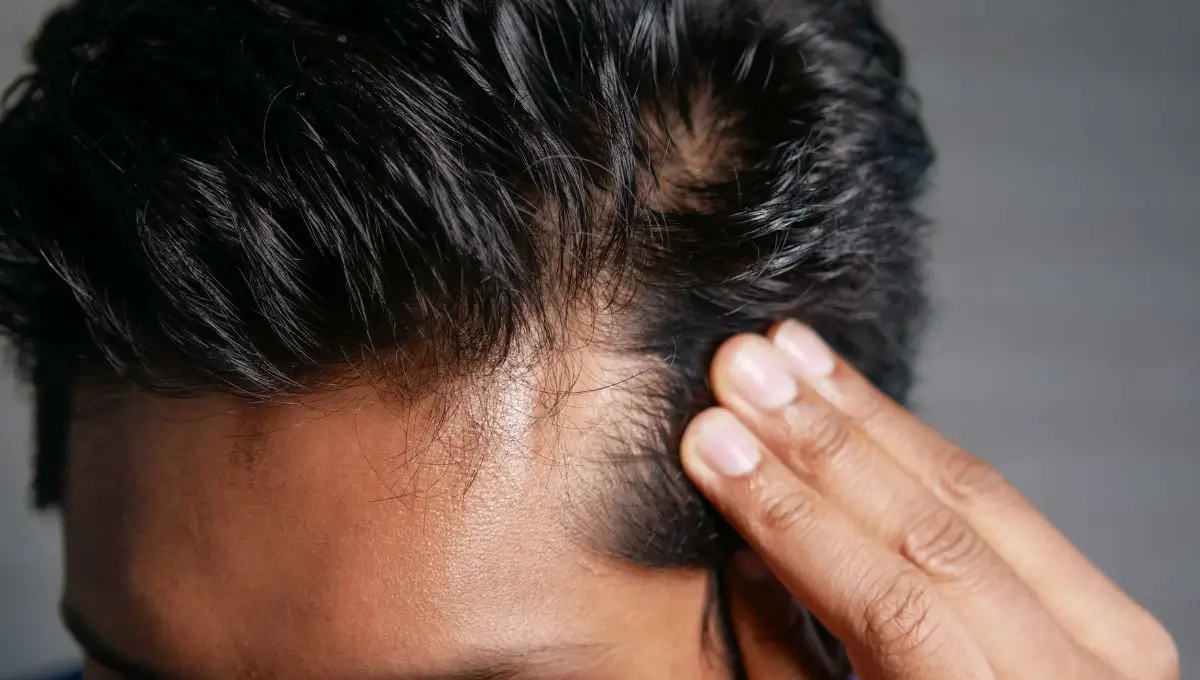
These are difficult consultations, and they are becoming more common. The 2025 ISHRS Practice Census found that the average share of hair transplant repair cases attributable to a previous black market hair transplant had reached 10%, up from 6% in 2021. In the same survey, 59% of member surgeons reported that black market clinics were operating in their own cities, up from 51%.
We think it is worth writing about what actually walks through the door, partly because almost nobody in this industry does, and partly because most of it is avoidable if you know what to look at before you book.
A note on what this post is not. We are not naming clinics and we are not going to imply that every disappointing result is somebody’s fault. Some of what we see is not a surgical error at all. And some of it, uncomfortably, was requested by the patient.
The hairline set too low, and too straight
This is the most common thing we see, and it is the one that ages worst.
Hairline design is an art, and a natural hairline is irregular. It has a soft transition zone, single-hair grafts at the leading edge, and it sits higher than most people in their twenties want it to. A hairline drawn low and straight looks dense in the first year and looks wrong for the next forty, because the face keeps changing shape and the hair behind it keeps receding.
The ISHRS lists hairlines placed too low or too straight among the most common reasons for corrective work, and adds a detail that gets left out of most discussions of bad transplants: younger patients in particular often push the surgeon toward an aggressive, low hairline. A surgeon who agrees has still made a mistake. But it is not always the surgeon who proposed it.
Repairing this is slow. It usually means removing or partially removing grafts, redistributing them, and rebuilding a transition zone, across more than one procedure.
Wrong angle, wrong direction
Hair does not grow straight out of the scalp. It exits at an angle that changes across the scalp, and at the crown it spirals outward from a whorl.
Grafts placed at the wrong angle grow in a direction that no hairstyle fixes. In the hairline this is immediately obvious, and the ISHRS notes that angle and direction errors are a recognised category of poor surgical technique. It is also the error that most clearly indicates who was holding the instrument, because recipient site creation is exactly the step that determines direction.
The donor area, which nobody photographs
Almost every before-and-after photo you have seen is of the front of someone’s head. The damage that is hardest to repair is at the back.
Two versions of it turn up. With strip harvesting, a scar that has widened or was placed badly. With FUE, overharvesting, which the ISHRS describes as leaving thin or moth-eaten areas. Take too many grafts from too small an area, or take them from outside the safe donor zone, and you produce visible patchiness in the one region that was supposed to stay dense for life.
This matters more than it sounds, because the donor area is the budget for every future procedure. Damage to the recipient area is a cosmetic problem. Damage to the donor area is a permanent reduction in what can ever be done.
Density that was never there
Low-density work with grafts spaced too far apart, or large grafts producing the coarse pluggy look associated with older techniques, both still turn up. The ISHRS documents both, along with a more serious complication: scalp necrosis, the death of skin and grafts in the treated area, resulting from poor surgical technique.
Volume is the common thread. A clinic running a very high daily caseload cannot have one surgeon performing every non-delegable step. The ISHRS census puts the average member surgeon at around 15 hair restoration surgeries per month, which the society frames as reflecting a hands-on approach rather than as a limitation.
The category that is not anyone’s fault
Some unnatural results are simply genetic hair loss doing what genetic hair loss does.
A patient has a well-executed transplant at 30. Over the following decade the native hair around and behind the grafts keeps receding, because they stopped medication, or medication became less effective, or enough time passed. What remains is a good transplant sitting in an unnatural pattern.
The ISHRS treats this as a distinct reason for revision, and notes that where a proper long-term plan was made before the first surgery, further procedures should improve the situation considerably. That is the whole argument for planning a transplant as a lifetime strategy rather than a single event, and it is the part of a consultation that patients are least interested in and that matters most.
Some of it cannot be fixed
This is the part we would rather patients heard from us than found out later.
Corrective work is limited by donor supply. If there is not enough donor hair left, repairing either continued loss or bad transplants may be challenging or impossible. The ISHRS says so plainly, and also says that there are occasions when no corrective work should be done at all: insufficient donor is one reason, and patient goals that are too ambitious for the remaining donor and the severity of the loss are another.
A badly planned repair makes things worse. It can produce more scarring and further damage to both the donor and recipient areas, which narrows the options that were left.
We turn down repair cases. Not often happily. But agreeing to operate on someone whose donor area cannot support the result they are describing is how a second bad outcome gets created, and the honest version of that conversation is more useful than a deposit.
What can often be done, when surgery is not the answer, is camouflage. Scalp micropigmentation uses pigment applied in fine dots to improve the appearance of thin or scarred scalp, and it can be used alongside surgery where donor hair is too limited to achieve density on its own. It is not the same as regrowing hair, and anyone presenting it as equivalent is overselling it.
If you think you need hair transplant repair work
A few things that are worth knowing before you start looking.
Hair transplant repair is close to a separate specialty. The ISHRS describes it as unlike routine transplantation and recommends finding a physician who works extensively with these cases, and specifically recommends asking to see examples of their repair work rather than their standard results.
Expect more than one procedure. Improvement, rather than erasure, is the realistic goal, and it usually arrives in stages.
If you want our view on a specific case, book a free consultation. Our surgical team will tell you what they think is achievable, including when the answer is that it is not.